Edit Check Harmonization
Bringing consistency to edit checks across studies
What it does
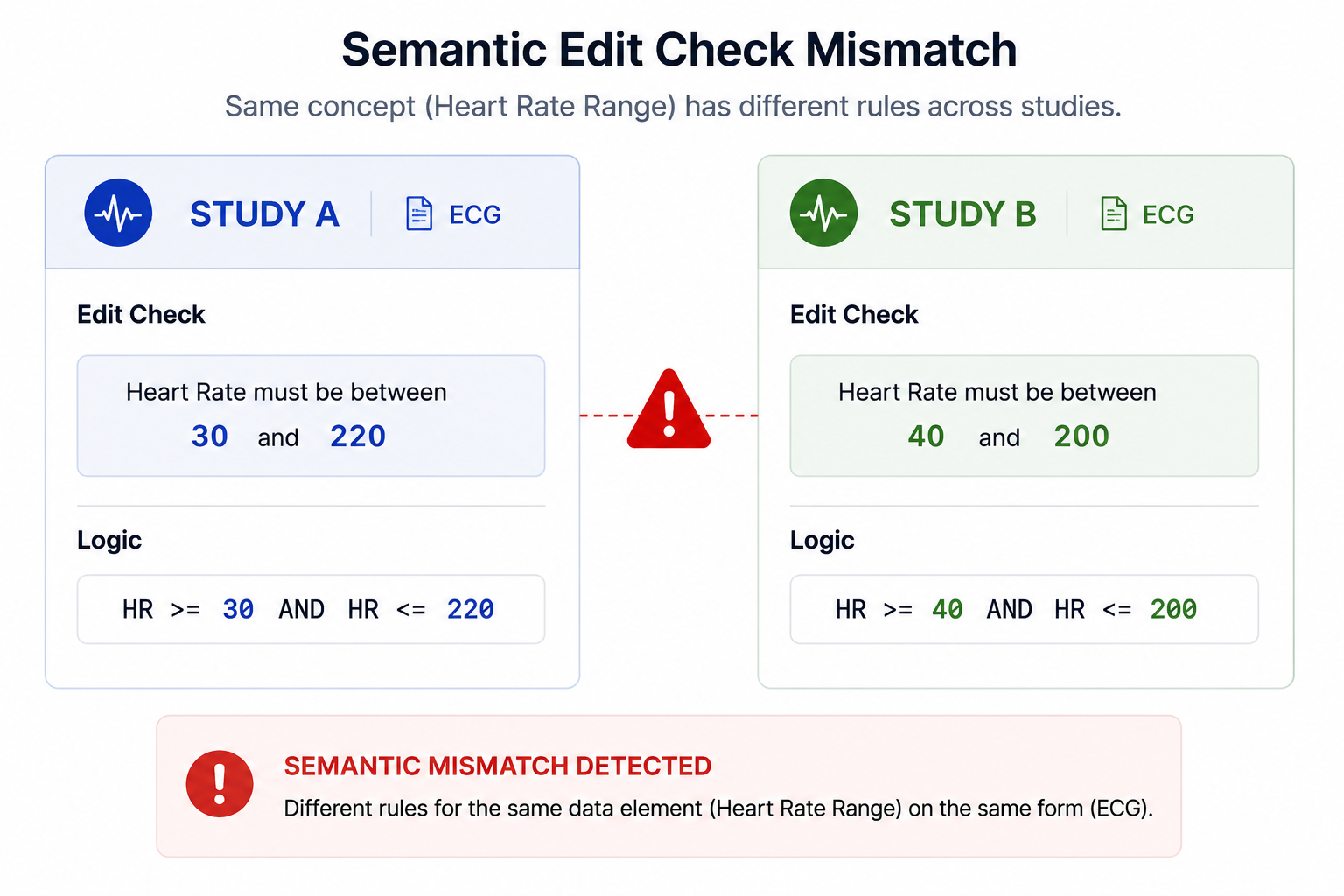
The Edit Check Harmonization Tool helps clinical data teams identify opportunities for greater consistency across studies by comparing edit checks based on meaning rather than wording alone. Using semantic similarity, the tool identifies checks with similar clinical intent and groups them for comparison, making it easier to spot differences in logic, thresholds, and implementation. Teams can then review these variations, identify reusable standards, and determine where harmonization may be appropriate. The result is a more efficient way to evaluate edit check libraries, reduce unnecessary variation, and support consistent data quality practices across studies and programs.
Problem solved
Edit checks designed for similar clinical concepts can vary significantly across studies in wording, logic, and thresholds. The tool makes these inconsistencies visible so teams can identify opportunities for standardization and reuse.
Best suited for
Clinical Data Management, Clinical Data Standards, Data Quality, and study teams managing or reviewing edit check libraries across multiple studies or programs.
Typical use
Compare in-development checks against established production patterns, evaluate whether standard checks are implemented consistently across studies, identify missing or inconsistent check logic across programs, and prioritize high-impact check concepts for harmonization based on reuse, variation, and study coverage.
Deployment
Downloadable
Implementation
A practical view of what it may take to use this product in your environment.
Implementation requirements
- Requires structured edit check specifications or libraries that can be exported into a tabular format such as Excel or CSV. Source data should include the edit check text or logic along with relevant study and metadata fields used for comparison. Field mapping may be required when combining specifications from different studies or standards.
Technical considerations
Semantic similarity is intended to support expert review rather than automatically determine equivalence. Results should be evaluated by clinical data or standards SMEs
particularly when checks have similar wording but different clinical context
forms
fields
or study-specific requirements.
Compliance & validation
Product information below is creator-supplied unless ClinExchange explicitly states otherwise.
Validation & review information
- Validation available: No / not stated
- Security review available: No / not stated