DecisionLENS
AI-powered clinical trial enrollment forecasting and data quality monitoring built on public ClinicalTrials.gov data
What it does
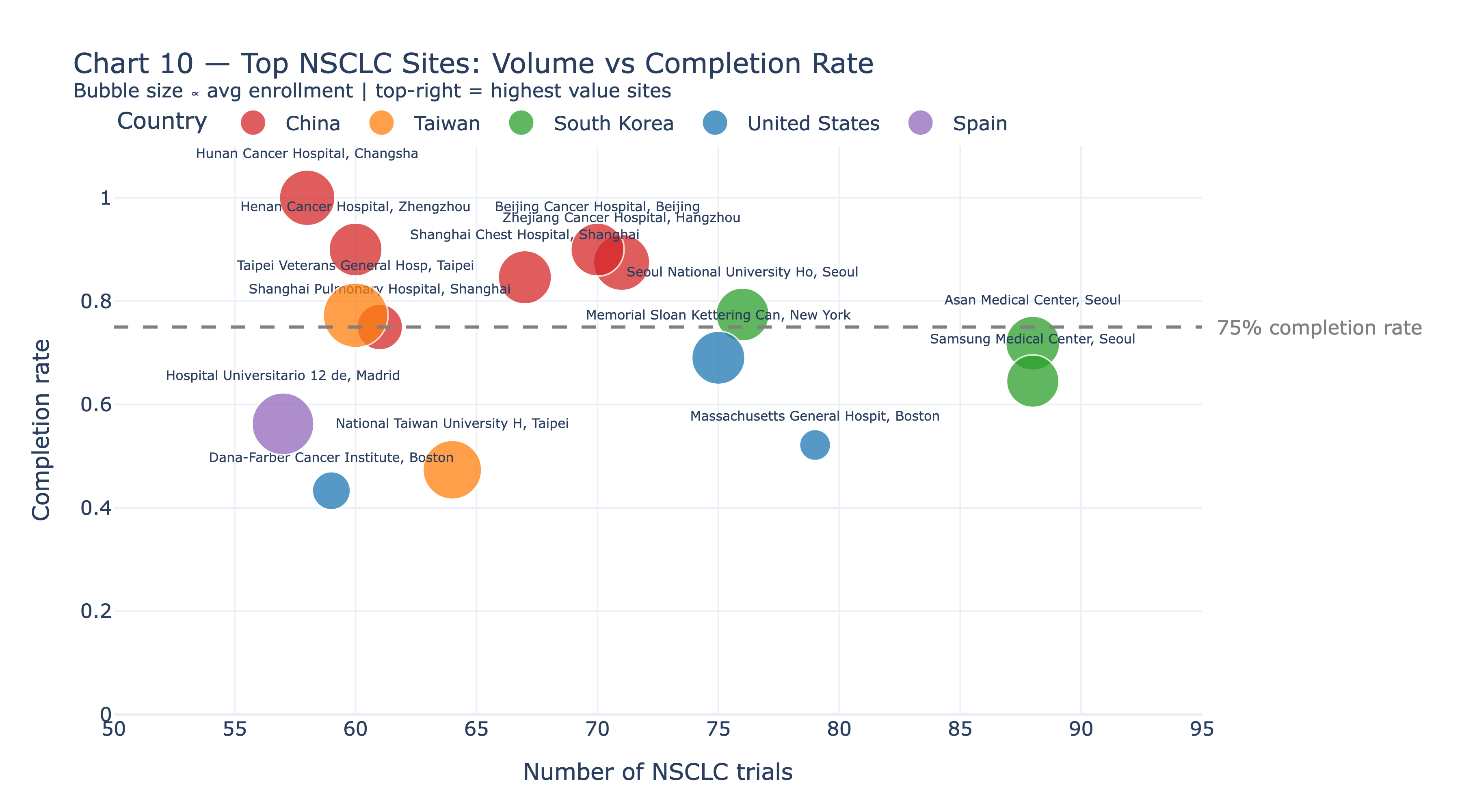
DecisionLENS covers two critical moments in the clinical trial lifecycle. Pre-trial design (v1): Helps operations teams evaluate trial feasibility before launch. Enrollment completion prediction (XGBoost, AUC 0.787, 5-fold CV) with threshold tuning for the terminated minority class. Cox PH survival modeling for time-to-completion estimates. SHAP explainability showing which design choices drive risk. Competitive landscape analysis across conditions, sponsors, and geographies. Site and country selection based on historical performance. An LLM-powered eligibility analyzer (Llama 3.3-70B) reads inclusion/exclusion criteria in natural language, flags restrictive criteria with severity ratings, suggests relaxations with estimated population impact, and generates executive briefings for non-technical stakeholders. The model performance section is deliberately transparent about limitations. Duration prediction R-squared is approximately 0.04 because AACT captures structural attributes but lacks the operational signals (site activation delays, protocol amendments, funding changes) that actually drive outcomes. This gap between registry data and operational context is a central design theme. In-trial data quality (v2): A LangGraph agent scans for issues across 7 check categories (temporal consistency, enrollment adequacy, endpoint completeness, cross-field validation, and cross-source verification against PubMed and OpenFDA). Findings are prioritised through a three-stage pipeline: deterministic rule engine, XGBoost risk model (AUC 0.799 on 22K real trials), and LLM assessment. Related findings are clustered into root cause hypotheses. Every finding carries full provenance for audit. Evaluation: 18-sample gold set, Cohen's kappa 0.596, CRITICAL precision 1.000 (zero false escalations). Per-call LLM tracing tracks tokens, cost, and latency.
Problem solved
Clinical trial enrollment failure is one of the most expensive problems in drug development. Operations teams design trials based on experience and intuition, often discovering feasibility issues only after launch when changes are costly. Once trials are running, data quality monitoring is largely manual and reactive, with critical issues buried in noise.
Best suited for
Clinical operations teams, clinical data managers, and biostatisticians at biotech and pharma sponsors. Particularly useful for small-to-mid-size sponsors without dedicated forecasting infrastructure, and for data management teams monitoring multiple concurrent trials.
Typical use
Before launch: configure a hypothetical trial (phase, sites, countries, sponsor type) and review completion probability, survival curve, SHAP risk drivers, and LLM eligibility analysis. Use the competitive intelligence module to assess patient pool saturation. After launch: run the v2 agent against active trial data to surface prioritised data quality findings grouped by root cause.
Deployment
Hosted Saas
Implementation
A practical view of what it may take to use this product in your environment.
Implementation requirements
- Web browser (for hosted demo)
- Python 3.10+ (for local installation)
- OpenAI API key (for v2 live agent mode only)
- Groq API key (for v1 eligibility analyzer
- optional)
Technical considerations
v1 demo is fully interactive with no API key required. v2 demo shows pre-computed scan reports. Live agent mode (v2) requires an OpenAI API key and runs scans in approximately 60 seconds per scope. All data is from public ClinicalTrials.gov (AACT) registry.
Compliance & validation
Product information below is creator-supplied unless ClinExchange explicitly states otherwise.
21 CFR Part 11
Structured provenance tracking and per-call LLM audit trails follow Part 11 design patterns (traceability, reproducibility). Not formally validated or submitted for regulatory review.
Validation & review information
- Validation available: No / not stated
- Security review available: No / not stated
- Privacy: All data sourced from public ClinicalTrials.gov (AACT) registry. No patient-level data, no PHI, no proprietary sponsor data. LLM calls use commercial APIs (OpenAI, Groq) with standard data handling. Local deployment option available for environments requiring data sovereignty.
Evidence
Enrollment prediction accuracy
XGBoost classifier ROC-AUC 0.787 (5-fold CV). Threshold tuned from 0.50 to 0.93 to improve sensitivity to terminated trials, doubling F1-Terminated.
Data quality severity classification
18-sample gold set evaluation: accuracy 0.722, Cohen's kappa 0.596, CRITICAL precision 1.000 (zero false escalations), 100% finding match rate.
Risk model performance
XGBoost risk model AUC 0.799 trained on 22K real AACT trials. Cox PH survival model on 46,897 observations for time-to-completion estimation.
Operational efficiency
v2 agent completes a full scan in approximately 60 seconds, 6 LLM calls, 5,484 tokens, at a cost of $0.002 per scan.
Creator
Yuan
Lead Data Scientist | Clinical AI & LLM Systems · IndependentPhysics PhD with 5+ years building production ML and LLM systems. Built DecisionLENS, an AI platform for clinical trial enrollment forecasting and data quality monitoring, using XGBoost, Cox PH survival analysis, LLM-powered text extraction, and agentic workflows (LangGraph). Background spans clinical trial analytics, causal ML, knowledge distillation, and on-premise deployment for regulated environments.