Cerberus
Building a traceable foundation for connected research data.
What it does
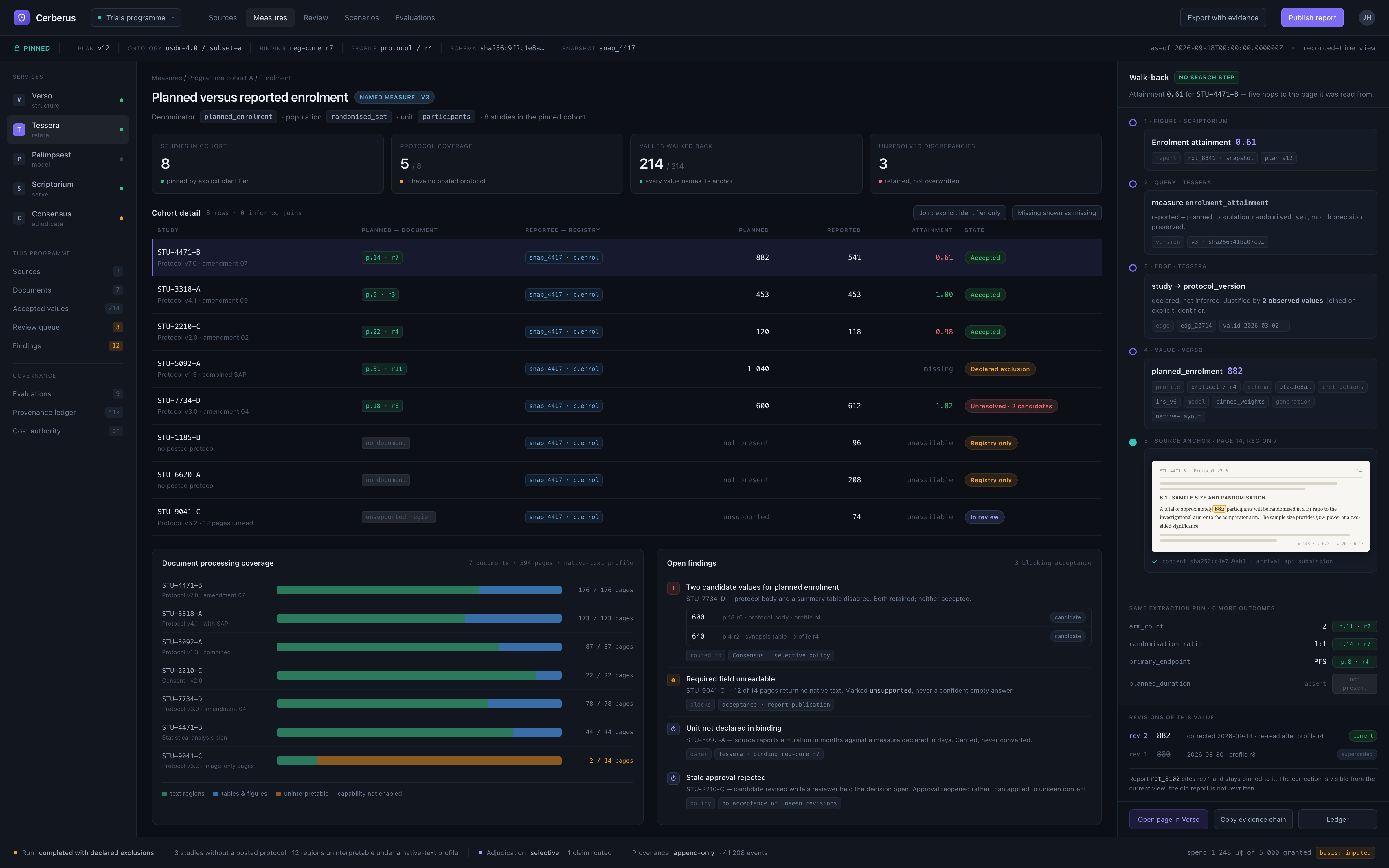
Cerberus is an in-development platform designed to preserve the evidence behind data as it moves from source documents and structured records into relationships, analysis and operational workflows. Its architecture combines document processing, evidence-backed data relationships, review of contested claims, workflow composition and separately governed scenario modeling. The central goal is to let a reviewer trace a derived result through the records and relationships that support it, back to the original source. The first demonstration workload uses historical clinical-trial protocols and registry records. The intended progression is to connect study evidence, compare values such as the enrollment target stated in an identified protocol version with reported actual enrollment, and later explore operational scenarios with explicit assumptions and sensitivity ranges. The platform is designed to support other domains through configuration as well. Development has established document-processing and evaluation foundations in Verso and tenancy/provenance foundations in the shared platform library. The relationship layer, workflow composer and simulation service remain unimplemented in the reviewed records. End-to-end lineage across joined sources and a validated clinical-trial simulator are development objectives, not current product claims. Contact the creator to discuss the development roadmap, potential research-data use cases and early collaboration.
Problem solved
Clinical research evidence is distributed across protocol PDFs, registry snapshots and operational datasets. When records are extracted, normalized and joined, it can become difficult to establish which source, version or interpretation supports a result. Cerberus is being built to preserve that chain of evidence and make uncertainty, conflicting claims and assumptions visible as data is connected and analyzed.
Best suited for
Clinical data and research informatics teams exploring traceable data integration Sponsor and CRO teams investigating cross-study evidence and retrospective analysis Research technology partners developing evidence-grounded analytical workflows Early collaborators able to help define representative datasets and evaluation criteria
Typical use
The planned clinical workflow connects a historical protocol with a matching registry record, establishes the version and context of each value, and lets a reviewer inspect the evidence behind a comparison. Later development will add operational scenarios over a pinned evidence base, keeping modeled assumptions and outcomes separate from observed facts. This describes the intended workflow; the complete sequence is not yet delivered.
Deployment
Hosted Saas
Implementation
A practical view of what it may take to use this product in your environment.
Implementation requirements
- A defined use case and bounded dataset
- Authorization to use the proposed source data
- Agreed source versions
- identifiers and comparison definitions
- Extraction and relationship configuration appropriate to the workload
- Reference cases and human reviewers for evaluation
- Creator-led technical scoping and development
Technical considerations
Cerberus comprises multiple components at different maturity levels. Verso contains document-processing and evaluation foundations
and the shared library implements tenancy and provenance foundations. Tessera
Scriptorium and Palimpsest—the relationship
workflow-composition and simulation components—remain unimplemented in the reviewed source records. Component checks do not establish end-to-end platform behavior. Cross-source lineage
customer deployment
self-service configuration and scenario validation remain development work.
Resources
Creator-supplied materials for evaluating the product.
Compliance & validation
Product information below is creator-supplied unless ClinExchange explicitly states otherwise.
21 CFR Part 11
Platform-level regulatory assessment is not complete. Provenance and review mechanisms in the design are not presented as a completed compliance assessment or validated production deployment.
Validation & review information
- Validation available: No / not stated
- Security review available: No / not stated
- Privacy: The initial clinical demonstration workload uses public historical trial records and posted documents. Patient-level clinical data is not needed for this initial workload. Customer data handling, provider routes, hosting, retention and access requirements must be established for any future engagement. The presence of component tenancy and provenance controls should not be taken as a claim that the complete platform is ready to receive patient information.
Evidence
Shared foundation verification
The September 16, 2026 closure record reports 108 passing tests and eight targeted mutation checks for the shared tenancy/provenance foundations. Later correction records refine that evidence; platform-wide service adoption remains open.
Historical trial-data feasibility audit
A documented development audit examined eight registry records and seven PDFs totaling 594 pages to characterize source shapes and gaps. This is a feasibility corpus, not a labeled accuracy benchmark or a clinical validation study.
Document-processing evaluation foundation
Verso's implementation includes an extraction-evaluation path that scores extracted values and source regions. This is component-level engineering capability; the platform's complete source-to-relationship-to-result chain remains in development.
Creator
Justin Howard
Technology Builder | Creator of Cerberus & Protocol Intelligence · Howard ITS (https://howardits.com)I’m a technology builder and the creator of Cerberus and Protocol Intelligence. My work centers on AI product development, evidence-backed reasoning, and translating complex requirements into practical software. Protocol Intelligence focuses on clinical-trial eligibility and protocol interpretation, helping users examine requirements, timing, exceptions, and contradictions while keeping conclusions anchored to source material. I’m also developing reusable infrastructure for source traceability and structured consensus, with connected data and measurable workflow planning on the roadmap. My goal is to build products that help research teams work more consistently, make reasoning easier to review, and preserve the evidence behind decisions. I’m interested in collaborating with sites, sponsors, CROs, and technology partners to address practical challenges in clinical research.